Showing posts with label TMJ. Show all posts

Tuesday, December 2, 2014

Screening for TMJ Dysfunction With Range of Motion Rulers

The American Dental Association (ADA) suggests that your dentist is the recommended professional to screen for TMJ dysfunction to his or her ability, and one of the quickest ways to screen for this dysfunction is to take a range of motion measurement of jaw opening.
Since the TMJ is the skeletal foundation of the craniofacial and masticatory system, a dysfunctional jaw joint can have adverse effects on the stability of the teeth and facial muscles.
Modern dentists have many ways that they can screen for TMJ dysfunction, including but not limited to:
  • Imaging (x-rays, MRI, CT scans)
  • Joint Vibration Analysis
  • Doppler
  • Auscultation (stethoscope)
  • Manual palpation
  • Medical history
A quick test that dentists may use to screen for TMJ dysfunction is to take a range of motion measurement. This is done using either a small range of motion scale ruler, boley gauge, or an orthodontic ruler.
What the dentist is looking for is to see if there is any restriction to opening the jaw. Like other joints in the body, the TMJ should be able to move freely without restriction. When there is dysfunction, like a restricted movement for example, it could signify that there is either a muscle problem or a locked jaw.
Locking Jaw
Dentists refer to a closed-lock jaw to the situation when the joint "disc" is stuck in front of the joint head (condyle), thus restricting movement upon opening. A range of motion scale measurement will show limiting at maximum opening. Typically, you should see a maximum opening of 40mm, or about the width of 3 fingers.
A limited range of motion in the jaw may suggest that there is a locked jaw, but it does not always mean that this is the case. As suggested, a limited range of motion can denote a muscle dysfunction, commonly seen in people who clench their teeth a lot and have sore facial muscles.
Dentists also use range of motion rulers to measure the distance that the jaw can move side-to-side. Known as lateral excursions, measuring the distance that the jaw can move side-to-side can tell the dentist if there is an issue with the jaw joint moving in and out of the proper position.
If the right jaw joint is dysfunctional for example, there may be issues moving the jaw to the left side. Abnormal chewing patterns using jaw tracking technology can also identify if there is dysfunction in either joint during masticatory movements.
Even with the abundance of advanced technology available for dentists, many will screen patients quickly at the exam with the aid of dental range of motion rulers.
Get some free samples of range of motion scales at DentalRulers.com and learn more about how these rulers can help with dental patient exams. Also get a Free Practice assessment at ProsperityInPractice.com.


Article Source: http://EzineArticles.com/8828704

Friday, March 9, 2012

TMJ Dysfunction -TMD and Temporomandibular Joint Anatomy

http://77e45kbmmjpd1l6f0aymnas28g.hop.clickbank.net/?tid=TMJBLOGGER


What is TMJ?
TMJ stands for Temporomandibular Joint. TMJ Dysfunction is any of the pathology associated with the TMJ.


To get a better understanding of TMJ Dysfunction and the causes, we will need to look at the anatomy of the TMJ.

Here, we'll look at the anatomy of the TMJ using the help of these diagrams:

Normal TMJ - no presence of TMJ dysfunction

In a healthy, normal TMJ, the articlular disc, or 'disc,' is properly placed in between the head of the mandible and the fossa (joint space). The disc is bi-concave in shape, concave on the top and bottom, and it acts as a barrier and lubrication between the head of the mandible (condyle) and the fossa.

While you open your jaw, the TMJ disc should stay in place during the movement process, and if it does not stay in place, that is when you start to have the clicking or popping sound.

Sometimes the posterior (back) ligament gets stretched out and the disc sits in front of the condyle. This is known as anterior disc displacement.

Anteriorly displaced disc - has TMJ dysfunction

Note how the retrodiscal tissues are stretched out and the bi-concave shape of the disc is anteriorly displaced. TMJ dysfunction occurs because when you open the jaw, the displaced disc "clicks" or "pops" back in place. Sometimes the click or pop is audible and can be heard, but at early stages or "partial disc displacement," the disc is not fully off of the condyle and often times there is no pain or uncomfortable feeling.

Depending on the trauma and the level of TMJ Dysfunction, the disc can be anteriorly displaced (in front), or it can be displaced to the side (medial or inside; lateral or outside).

What is TMJ?
Since TMJ is "Temporomandibular Joint, everybody has TMJ! In fact, they have two. So, when someone says, "I think I may have TMJ." What they really mean is, "I think I may have TMJ Dysfunction."

Generally speaking, dentists are the most knowledgeable professionals to treat the TMJ and TMD.  However, not all dentists know about the TMJ (find out more at TMJ Dysfunction).


For more information on TMJ Dysfunction, visit: TMJDysfunction.net


TMJ Symptoms - What TMJ Symptoms may be TMJ Dysfunction?

There are many TMJ symptoms that may arise from TMJ dysfunction, which is why the condition is sometimes referred to as "The Great Impostor" by health care professionals.

Common symptoms include persistent headaches or popping and clicking of the joint.  If the TMJ is in the incorrect position during jaw closing, too far into the socket, there are nerves and blood vessels that can get compressed.  Since the head is incredibly vascularized with blood vessels, the constriction of these nerves and blood vessels can be a main reasons that migraines and headaches occur.

Also, due to the close proximity to the ear canal (see TMJ Anatomy page), an improperly positioned and functioning TMJ can cause repeating ear infections, tinnitus or ringing in the ears, vertigo or lack of balance and spatial awareness, and direct ear pain.

Since the joint is encapsulated by a number of muscles including the masseter and lateral pterygoids, muscular facial pain is sometimes a symptom of TMJ dysfunction.  If you have bruxism, or clenching habits (whether at night or during daytime activities), the constant working of these muscles can pull and tug on the joint and create  TMJ dysfunction.  

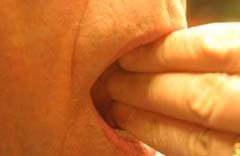
Some other TMJ symptoms to watch for are a limited range of motion and a crooked opening.  A simple way to see if your range of motion is limited is by seeing if you are able to comfortably fit the width of three fingers in your mouth.

3 Finger Test
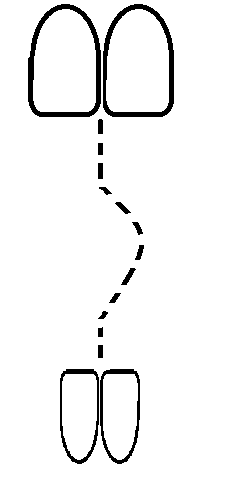
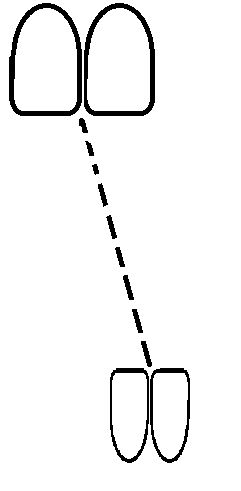
If you watch yourself in the mirror and open your jaw and you find either a deviation or deflection, this is a sign that the TMJ is not functioning properly since the disc is getting stuck during opening.

Deviation

Deflection
Note the difference between Deviation and Deflection.

If you jaw is showing deviation, this means that the disc is getting caught on one side and then releasing at a different time than the opposing joint, so in turn the jaw comes back to center.  If you are showing deflection, there is a partial closed lock, because one side the disc is moving properly and on the other side it is not.

If you are experiencing any of these symptoms, you may need to see your dental health professional for recommendations.


How is TMJ dysfunction diagnosed?

How is TMJ diagnosed?

There are many schools of thought as to how TMD can be diagnosed.  Coincidentally, there are many health professionals that may assist with diagnosing TMD ranging from psychologists to physicians and most commonly, dentists.


Here are some of the most common methods of diagnosing:

  1. Muscle palpation - Usually done by a dentist, palpating the muscles with constant pressure can show an imbalance of forces or unnatural trigger points in the functional muscles of the jaw, including the masseter, temporalis anterior, and lateral pterygoid.
  2. Electromyography of the Muscles (EMG) - more objective than palapation, the facial muscle hyperactivity can be quantified and the imbalances of muscles during functional clench can be established by an EMG device.
  3. Radiography/Imaging - X-rays (static or panographic), Cephalograms (an x-ray image of the structures of the head), MRI (magnetic Resonance imaging), CBCT (Cone Beam Computed Tomography) or 'Tomo', are all examples of static images that can detect derangement and degeneration of the TMJ bony structures.  However, imaging is limited because it takes a static (still) image and does not capture the TMJ in function and movement.
  4. Symptoms questionnaire/Gathered symptoms - the health professional can do an extensive exam, and by learning about all of the symptoms in combination with muscle exams.e
The bottom line is that if you think you have TMJ symptoms, you should seek professional help to get the most accurate TMJ diagnosis.  Generally speaking, dentists will have the best experience with diagnosing the disorder, but that is not always the case.  

Also, TMD is a widely disagreed upon diagnosis, usually due to the lack of objective methods used for diagnosis and the amount of weight that is placed on patient symptoms.  For example, patients may complain of headaches, ear pain, facial muscle pain, back pain, pressure in the sinuses, tooth pain, and pressure behind the eyes.  Two different doctors might diagnose this differently and formulate different conclusions.

In conclusion, be sure to do diligent research on the health professionals you are thinking of visiting in your area.  Learn more about TMJ and TMD and get your FREE TMJ Report and free newsletter at http://tmjdysfunction.net.

Treatment for TMJ Dysfunction: Which TMJ Treatment is Best?

There are many different treatments for TMD.  And depending on which health care professional you see, you might get a different result.

Generally speaking, your dentist should be the most qualified to treat TMD.  The ADA states that dentists should help diagnose TMD to the best of their ability.  However, many dentists only have a limited knowledge of TMJ dysfunction, unless they have taken enough continuing education to develop the knowledge to treat the condition.

Other health care specialists that treat TMJ dysfunction include medical doctors/physicians, chiropractors, ENT  (ear, nose, throat) specialists, oral surgeons, massage therapists, accupuncturists, neurologists, and psychologists.

Here is a list of some of the options for treatment of TMJ dysfunction:

  • Surgery to reconstruct the joint capsule and disc
  • Stretching to relax the muscles
  • Mouth guards or splint designed by your dentist to re-position the mandible and properly re-align the joint disc
  • Accupuncture
  • Medications (anti-inflammatories, such as ibuprofen or muscle relaxants)
  • Chiropractic treatment
  • Cortisone or other injection
  • Holistic methods
  • Cold laser therapy
Which is the best treatment for TMJ dysfunction?  It depends who you ask.  Be sure to speak with all of your health care professionals to get the best treatment option for you.  If you'd like to learn more about TMJ dysfunction (TMD), get the FREE Report at http://tmjdysfunction.net


What is TMJ - A Basic Understanding of TMJ and TMJ Dysfunction (TMD)

What is TMJ?

TMJ is an acronym for "Temporomandibular Joint." The TMJ is a complex joint, similar to the knee, because it has multiple dimensions of movement in normal activity - it can rotate and translate.

During normal jaw opening, the TMJ first rotates, then translates along the fossa, or joint socket, and it is supported by a lubricating disc. Since the TMJ is a very complex joint, it is very susceptible to trauma. The trauma can lead to problems of the joint, also known as TMJ dysfunction, or TMD.

 So when people say they are affected by "TMJ" they actually are talking about the condition known as TMJ dysfunction or TMD!


What Causes TMJ Dysfunction?

TMJ Dysfunction is a common, often misdiagnosed pathology and is often called "The Great Impostor" because of the many symptoms that can arise it.  TMJ Dysfunction (or TMD) is the general term for the symptoms of abnormal joint function.

Some TMJ symptoms include:

Generally speaking, there are two reasons we see TMJ dysfunction in patients - microtrauma and macrotrauma.

The first, microtrauma, is a class of TMJ symptoms caused by any type of trauma that occurs internally.  Habits such as parafunctional (outside of function, or abnormal) clenching of the teeth is a common cause.  Signs and symptoms include worn down teeth, sore facial muscles, and a scalloped tongue - grooves in the tongue surface where the tongue rests during clenching activity.

Another microtrauma is teeth grinding, or bruxism.  The constant wear and tear of forces on the facial muscles and teeth cause stress on the joint, which can lead to further TMJ dysfunction.  If you experience bruxism or clenching, a night guard may provide some relief.

Other trauma causing TMJ Dysfunction could be osteoarthritis of the joint or rheumatoid arthritis.

Macrotraumas are TMJ symptoms that include anything external, such as a blow to the face from physical activity or auto accidents for example.  If you have an excessive traumatic force that would allow the joint to be dislocated, this could stretch the posterior ligaments of the TMJ and permanently damage the joint.


Stages of TMJ Dysfunction - Videos of the TMJ Anatomy

Here are the stages of the TMJ Dysfunction:

Normal Temporomandibular Joint (TMJ):

Notice the bi-concave shape of the disc, and it consistently stays between the condylar head and the articular eminence.  When the mandible is closed, note that the joint is more down and forward as opposed to up and back, leaving room for the blood vessels and nerves posteriorly.


Anterior Disc Displacement With Reduction (Disc is sitting in front -anterior to the joint head and reduces, or moves back to the normal position upon opening)


In this case, you can see that the ligaments are more stretched out, leaving the disc anteriorly displaced on the joint, so that when the jaw opens, it 'clicks' or 'pops' back in place, and a second 'click' occurs during closing.


Medio-laterally displaced disc of TMJ Dysfunction (disc moves toward mid-line and re-appears as it moves laterally toward side of face)


In this example of TMJ Dysfunction, the disc displaces (moves out of position) and reduces (moves back into the proper position) medio-laterally.


Degenerative Joint Disease with Perforation (ligament and/or joint tear)


This shows when the last stage of TMJ Dysfunction where the disc is perforated and thus positioned completely in front of the condyle.  There is no longer that bi-concave shape, and you can notice the flattening of the condyle (head)  due to the continuous bony tissue contact with adjacent bony cavity.  Note also how the shape of the cavity has changed (it used to be round, now has flattened).


This example shows a Disc Displacement withOUT reduction, or Chronic DD. Note the disc is stuck in front of the condyle and cannot recapture or reduce.


Welcome to TMJ Dysfunction.net

Welcome to TMJ Dysfunction dot net!  This site contains updates on TMJ Dysfunction and Temporomandibular Joint posts.  Be sure to sign up to our TMJ Newsletter to receive the most up to date info on TMJ symptoms, treatment, and health.

Wednesday, December 14, 2011

TMJ TMD - 3 Tips How to Find a Good TMJ Dentist in Your Area

3 Tips how to Find a Good TMJ Dentists in Your Area:There are few tips I recommend when starting your search for a good TMD Dentist in your hometown.
Follow these quick pointers and you'll find yourself in the care of a knowledgeable clinician who will care for you best!
  1. Ask your existing Dentist!  When confronted with the question, "What's your level of expertise in Treating TMD?", most dentists will either tell you they can treat, or if not don't be shy to ask for your best referral.  Be sure to use the term "TMD" because then they will know you are EDUCATED!!
  2. After finding your Top 5 either from referrals or looking in your phone book (or web directory), CALL each office and ask if they have 2 things: 1) a "JVA" or "Joint Vibration Analysis".  This device is the Quickest way to determine if your joint disc is out of place.  2) "EMG" Electromyography or Facial muscle test machine.  This will determine if your facial muscles are hyperactive and causing joint problems.   If they have no idea what you're talking about, call the next person on the list!
  3. Ask how many hours of continuing education the dentist has had in TMD.  If they do not have any, you know the doctor is not a good choice!
If you would like to try a more traditional, at-home approach for mild symptoms, try these methods by a Certified Nutritionist with thousands of hours of TMD knowledge!  Click here to learn more!


Yours in Health -
TMJDysfunction.net

Tuesday, July 12, 2011

What is TMJ - Article

What is TMJ?The temporomandibular joint is the hinge joint of the jaw that connects the lower jaw (mandible) to the temporal bone of the skull. This joint is an articular disc composed of fibrocartilagenous tissue. It comprises, all in all, of six parts: mandibular condyles, articular surface of the temporal bone, capsule, articular disc, ligaments and lateral pterygoid. The TM Joint facilitates movement of the jaws, thereby allowing essential functions like talking, eating and swallowing. Needless to say, the slightest afflictions caused to this joint, disrupt a great deal of its basic functions. The most common affliction that occurs is the TMJ Disorder. So, what is TMJ Disorder?

The TMJ Disorder is a term used to describe an acute inflammation of the TM Joint. It is categorized in three ways:

1. By myofascial pain: The fascia is the tissue that connects the different parts of your body. Fascia around the muscles is called myofascial. Thus, any injury to the myofascial, will automatically adversely affect the muscles. The most common TMJ disorder is associated with myofascial pain in the jaw muscles and neck.

2. By internal injury: Any dislocation, injury, or indeed, any derangement in the joint results in TMJ disorder.

3. By degenerative joint disease: Problems like osteoarthritis or rheumatoid arthritis of the jaw are underlying causes of TMJ disorder. It can't be stated for certain what exactly causes TMJ disorder, although there are some standard contributing factors. These can be classified into dental issues (such as ill fitting dentures, tooth removal, missing teeth etc), injury or trauma (on or around the jaw), bad habits (like bruxism or wrong sleeping postures), social situations that cause stress and emotional upheavals (such as depression, anger or fear).

There are a number of signs that you can recognise as underlying symptoms of TMJ disorder. The most likely symptom is otalgia, more commonly known as earache. Since the TMJ is so close to the ear, if there's a disorder in the TMJ, there are bound to be repercussions in the ear. The other fairly common symptom is toothache. Although toothaches are caused due to a number of reasons, a TMJ disorder may bring about toothaches, tooth mobility or even tooth loss. Usually, if the above listed signs are accompanied by headaches, they could be signalling a chronic TMJ disorder.

A number of remedies are available for those suffering from TMJ disorder. In the initial stages of the condition, treatments like heat and ice therapy, or jaw resting techniques are used. Pain medications such as ibuprofen and naproxen are also prescribed. Corrective dental surgeries are used if the condition worsens. Sometimes a splint or bite plate may be required to be introduced. Non invasive and natural cures are also available. These may include stress reduction therapies, soft food diets and face and neck exercises.

For conditions like TMJ disorder, it is always advisable to take a multi dimensional approach. A holistic treatment strengthens your body from within. Therefore, it is much more affective to combine alternative and conventional treatments for long lasting relief. Thus, working on stress reduction methods, along with following a soft food diet and a face and neck exercise routine can go a long way in not only healing the TMJ disorder but also in preventing it from happening again. 


This article is based on the book, "TMJ No More" by Sandra Carter. Sandra is an author, researcher, nutritionist and health consultant who dedicated her life to creating the ultimate TMJ disorders solution guaranteed to permanently reverse the root cause of TMJ and dramatically improve the overall quality of your life,  without the use prescription medication and without any surgical procedures. Learn more by visiting her website:
TMJ No More