Showing posts with label TM Joint. Show all posts

Friday, March 9, 2012

TMJ Symptoms - What TMJ Symptoms may be TMJ Dysfunction?

There are many TMJ symptoms that may arise from TMJ dysfunction, which is why the condition is sometimes referred to as "The Great Impostor" by health care professionals.

Common symptoms include persistent headaches or popping and clicking of the joint.  If the TMJ is in the incorrect position during jaw closing, too far into the socket, there are nerves and blood vessels that can get compressed.  Since the head is incredibly vascularized with blood vessels, the constriction of these nerves and blood vessels can be a main reasons that migraines and headaches occur.

Also, due to the close proximity to the ear canal (see TMJ Anatomy page), an improperly positioned and functioning TMJ can cause repeating ear infections, tinnitus or ringing in the ears, vertigo or lack of balance and spatial awareness, and direct ear pain.

Since the joint is encapsulated by a number of muscles including the masseter and lateral pterygoids, muscular facial pain is sometimes a symptom of TMJ dysfunction.  If you have bruxism, or clenching habits (whether at night or during daytime activities), the constant working of these muscles can pull and tug on the joint and create  TMJ dysfunction.  

Some other TMJ symptoms to watch for are a limited range of motion and a crooked opening.  A simple way to see if your range of motion is limited is by seeing if you are able to comfortably fit the width of three fingers in your mouth.
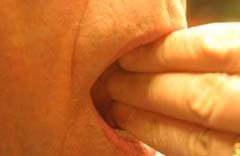
3 Finger Test
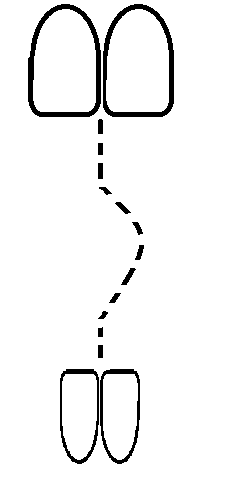
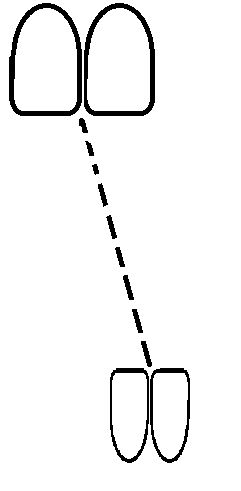
If you watch yourself in the mirror and open your jaw and you find either a deviation or deflection, this is a sign that the TMJ is not functioning properly since the disc is getting stuck during opening.

Deviation

Deflection
Note the difference between Deviation and Deflection.

If you jaw is showing deviation, this means that the disc is getting caught on one side and then releasing at a different time than the opposing joint, so in turn the jaw comes back to center.  If you are showing deflection, there is a partial closed lock, because one side the disc is moving properly and on the other side it is not.

If you are experiencing any of these symptoms, you may need to see your dental health professional for recommendations.


What Causes TMJ Dysfunction?

TMJ Dysfunction is a common, often misdiagnosed pathology and is often called "The Great Impostor" because of the many symptoms that can arise it.  TMJ Dysfunction (or TMD) is the general term for the symptoms of abnormal joint function.

Some TMJ symptoms include:

Generally speaking, there are two reasons we see TMJ dysfunction in patients - microtrauma and macrotrauma.

The first, microtrauma, is a class of TMJ symptoms caused by any type of trauma that occurs internally.  Habits such as parafunctional (outside of function, or abnormal) clenching of the teeth is a common cause.  Signs and symptoms include worn down teeth, sore facial muscles, and a scalloped tongue - grooves in the tongue surface where the tongue rests during clenching activity.

Another microtrauma is teeth grinding, or bruxism.  The constant wear and tear of forces on the facial muscles and teeth cause stress on the joint, which can lead to further TMJ dysfunction.  If you experience bruxism or clenching, a night guard may provide some relief.

Other trauma causing TMJ Dysfunction could be osteoarthritis of the joint or rheumatoid arthritis.

Macrotraumas are TMJ symptoms that include anything external, such as a blow to the face from physical activity or auto accidents for example.  If you have an excessive traumatic force that would allow the joint to be dislocated, this could stretch the posterior ligaments of the TMJ and permanently damage the joint.


Stages of TMJ Dysfunction - Videos of the TMJ Anatomy

Here are the stages of the TMJ Dysfunction:

Normal Temporomandibular Joint (TMJ):

Notice the bi-concave shape of the disc, and it consistently stays between the condylar head and the articular eminence.  When the mandible is closed, note that the joint is more down and forward as opposed to up and back, leaving room for the blood vessels and nerves posteriorly.


Anterior Disc Displacement With Reduction (Disc is sitting in front -anterior to the joint head and reduces, or moves back to the normal position upon opening)


In this case, you can see that the ligaments are more stretched out, leaving the disc anteriorly displaced on the joint, so that when the jaw opens, it 'clicks' or 'pops' back in place, and a second 'click' occurs during closing.


Medio-laterally displaced disc of TMJ Dysfunction (disc moves toward mid-line and re-appears as it moves laterally toward side of face)


In this example of TMJ Dysfunction, the disc displaces (moves out of position) and reduces (moves back into the proper position) medio-laterally.


Degenerative Joint Disease with Perforation (ligament and/or joint tear)


This shows when the last stage of TMJ Dysfunction where the disc is perforated and thus positioned completely in front of the condyle.  There is no longer that bi-concave shape, and you can notice the flattening of the condyle (head)  due to the continuous bony tissue contact with adjacent bony cavity.  Note also how the shape of the cavity has changed (it used to be round, now has flattened).


This example shows a Disc Displacement withOUT reduction, or Chronic DD. Note the disc is stuck in front of the condyle and cannot recapture or reduce.


Welcome to TMJ Dysfunction.net

Welcome to TMJ Dysfunction dot net!  This site contains updates on TMJ Dysfunction and Temporomandibular Joint posts.  Be sure to sign up to our TMJ Newsletter to receive the most up to date info on TMJ symptoms, treatment, and health.